Two live Jev demos, reviewed: a testnet market maker and a Jev-powered autopilot
We spent time with two public Jev demos — Jev Trader, which makes a buy/sell call on every Monad block, and JevPilot, a driving simulator with a Jev autopilot. Screenshots, observations, and what each one teaches about judgment models.
Reading about "typed decisions" is one thing. Watching a model actually make one — every few seconds, in public, with its misses on display — is another. That's exactly what two live demos of the Jev model offer, so we spent an afternoon with both, took screenshots, and wrote up what we saw.
Demo 1: Jev Trader — one buy/sell judgment per block, in public
Jev Trader (source on GitHub, ~1.7k stars at the time of writing) is a market-making bot that runs on the Monad testnet. It posts a standing order on Kuru's MON/USDC order book — the site's own tagline is blunt: "post a bid or an ask on Kuru's MON/USDC book. every block. no abstaining."
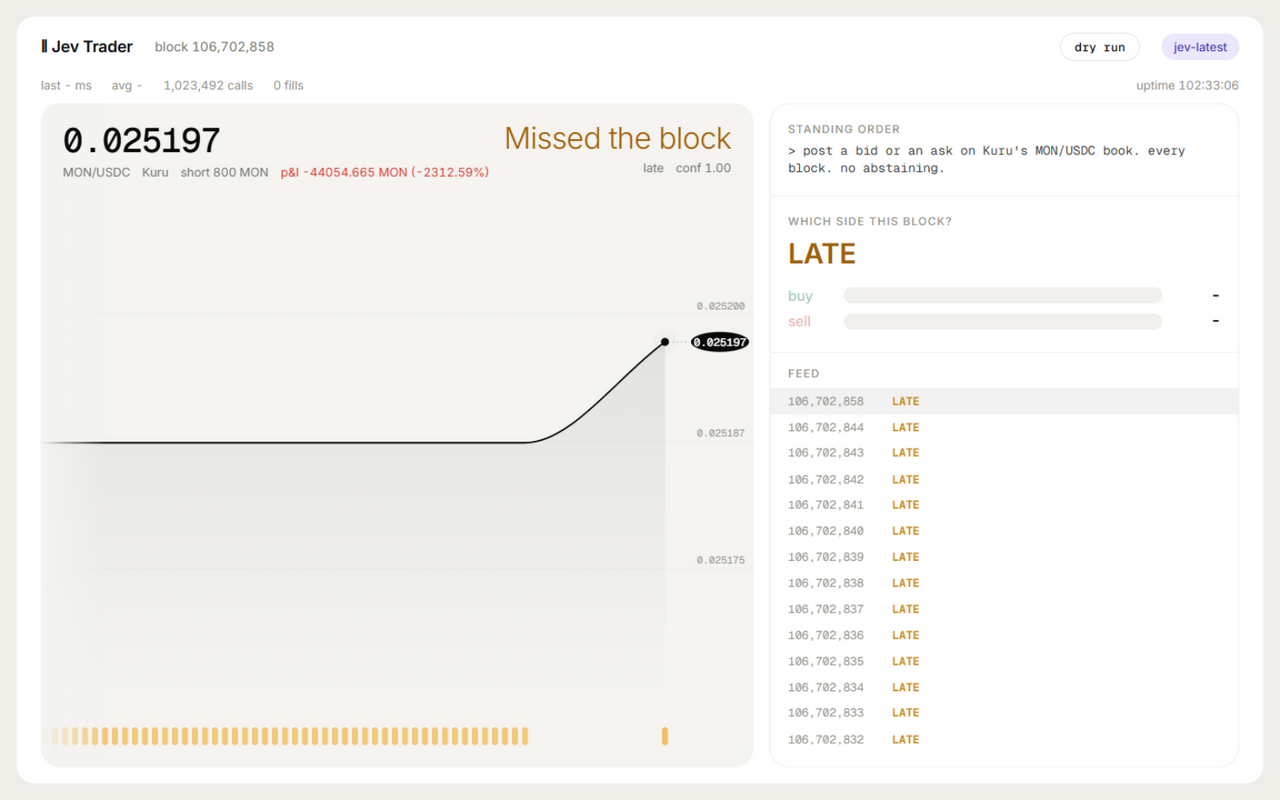
Every block, the bot asks Jev (the dashboard shows the model, jev-latest at our visit) one question: which side this block — buy or sell? The answer streams to a public dashboard alongside a live block feed, a confidence readout, and running counters for calls, fills and uptime.
What we actually observed
- The decision loop is visible in real time: a new block number ticks up, the buy/sell panel updates, and a confidence value (1.00 at our visit) is shown next to the call.
- The dashboard does not hide failure. The P&L panel showed a large negative number, many feed entries were flagged LATE or "missed the block", and fills stayed at zero during our visit — all displayed rather than tucked away.
- A "dry run" toggle exists but was disabled at the time of our visit.
- Counters suggested the bot had been running for a long time (uptime was past 100 hours with over a million recorded calls).
Our take
As a teaching artifact, this is close to ideal. The whole pitch of a judgment model is "cheap, fast, structured decisions at high frequency" — and here you can literally watch the decision happen every block, with the model name and confidence on screen. The honesty is the best part: a losing P&L, late blocks and zero fills during our visit make it clear this is a live experiment, not a highlight reel.
It's equally important not to over-read it. Testnet economics, no realistic slippage, a forced decision every single block ("no abstaining" is deliberately brutal), and latency flags everywhere mean the visible P&L tells you nothing about trading edge. What it does demonstrate convincingly is decision cadence, transparency of the loop, and how a binary Choice-style judgment slots into an event-driven system.
Demo 2: JevPilot — take Jev for a drive
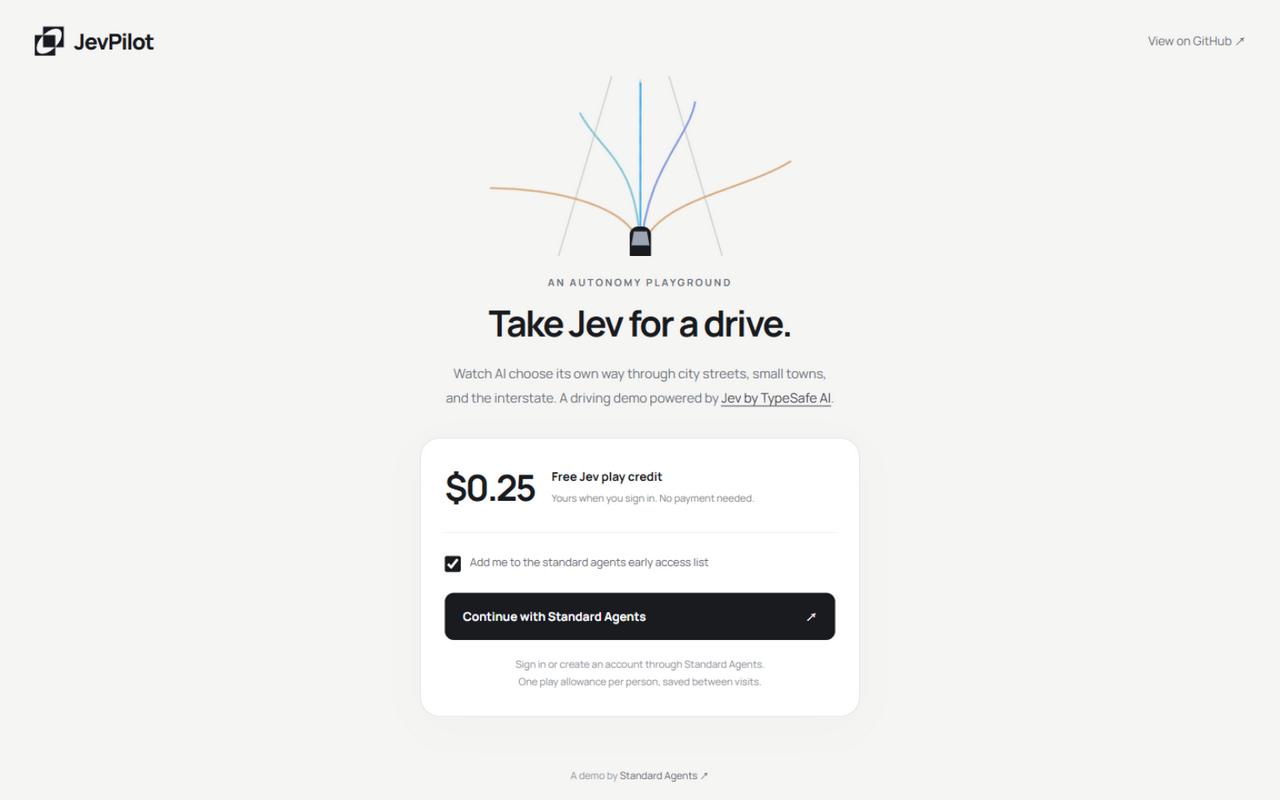
JevPilot (source on GitHub, ~140 stars) is the second kind of demo: a playable Three.js driving simulator where the autopilot is Jev. The landing page pitches it simply — "Watch AI choose its own way through city streets, small towns, and the interstate."
What we actually observed
- The demo is gated: you sign in with a Standard Agents account, and the page states each person gets a one-time $0.25 allotment of Jev play credit — no payment needed.
- The repo describes itself as a playable Three.js driving simulator with a Jev-powered autopilot, and the landing page frames it as an "autonomy playground".
- We signed in with a Standard Agents account to capture the driving view itself; the in-simulator observations below come from that session.
What the driving view shows
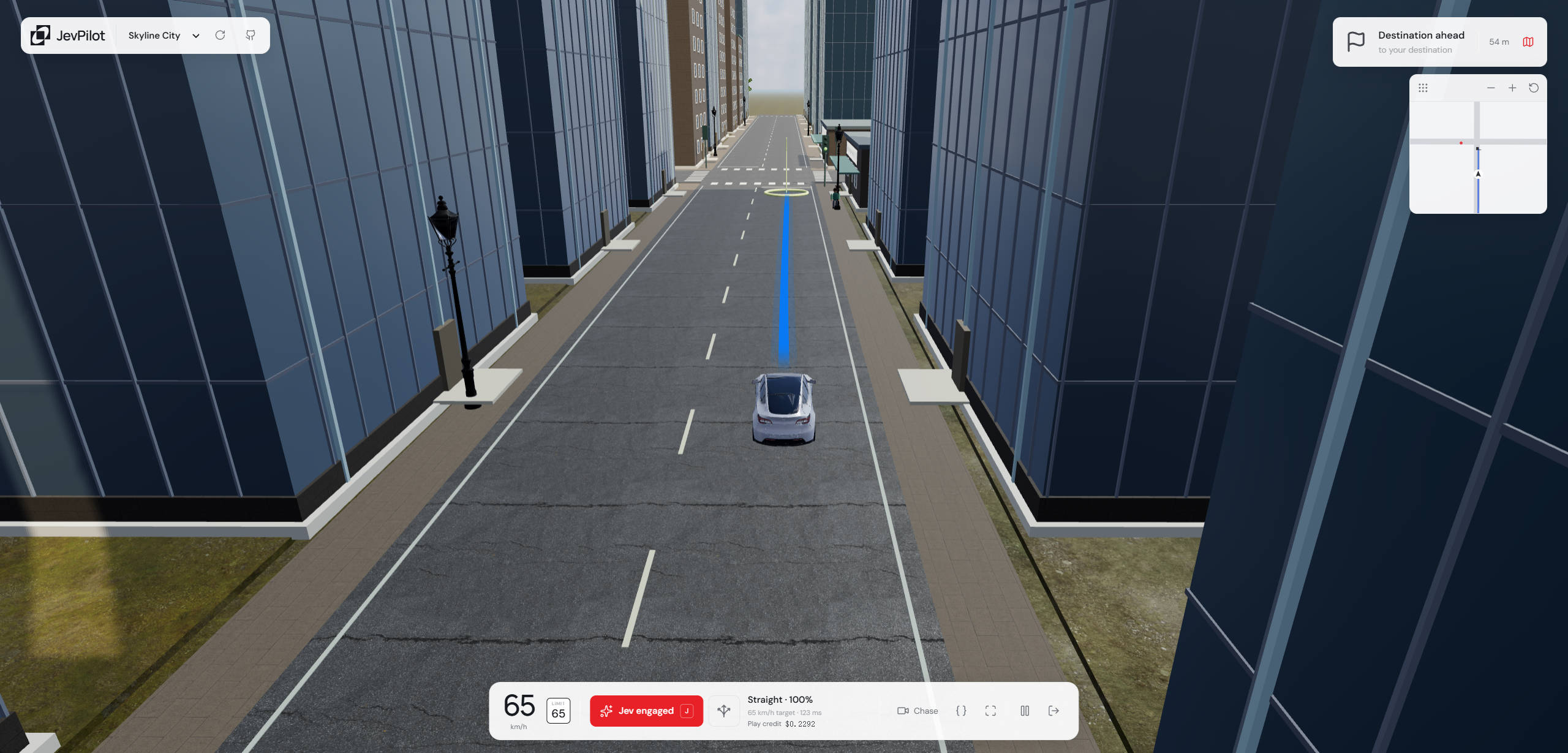
- The autopilot's intent is rendered directly in the world: a blue path-planning beam projects from the car and ends in a yellow target ring — you can see where the model intends to steer before it does.
- The HUD keeps the loop legible: a destination card (54 m ahead at capture), a minimap with the planned route, a speedometer next to the posted limit (65 km/h at capture), and a prominent "Jev engaged" state.
- Route statistics are exposed too — at capture, "Straight · 100%" with turn counts and projections alongside.
- Most notably for anyone running demos on metered APIs: the remaining play credit is displayed live in the HUD ($0.33 at capture). Cost burn is part of the interface, not hidden in a billing page.
Our take
Structurally, this is the same pattern as Jev Trader, transplanted from markets to steering: a simulated world, a tight control loop, and Jev making the per-tick judgment. What makes it click is that the judgment is visualized — the blue beam is the steering equivalent of Jev Trader's flashing buy/sell panel. You watch the model's intention, not just its consequences.
The credit gating remains the quietly smart design detail. Real-time demos burn real API budget, and "one play allowance per person, saved between visits" plus a live credit readout in the HUD is a clean, honest way to keep a free public demo solvent. It's the same problem we solve on this site with one-time visitor credits — just with accounts instead of cookies.
Two demos, one idea
Put side by side, the two demos make the same point from opposite directions. Jev Trader runs a judgment loop against real (testnet) market events and shows everything, warts included. JevPilot runs a judgment loop inside a simulated world and gates access to control its costs. Both treat the model as what it is: a fast, cheap opinion machine that your code acts on — not a language model writing essays about what it would do.
That's also exactly how our playground works: your text is the state, the scenario's fixed questions are the judgments, and the answers come back as probabilities and scores you can branch on. If either demo made you curious, you can run the same primitives yourself in a few seconds:
And if you want the broader tour — browser agents, coding tools, MCP integrations, knowledge graphs, more games — we keep a growing directory:
How we reviewed
- Both sites were visited on September 21, 2026 (UTC); screenshots are ours from those visits.
- For JevPilot, one of us signed in with a Standard Agents account to capture the in-simulator driving view; the landing-page observations come from the public page.
- Facts about each project come from its live site and its public GitHub repository; we did not republish performance claims we couldn't verify.
- Opinion paragraphs are labeled as our take. Neither project was contacted, and neither has any relationship with this site.